Georgia Tech Hosts the Regional, With Big Sticks Ready

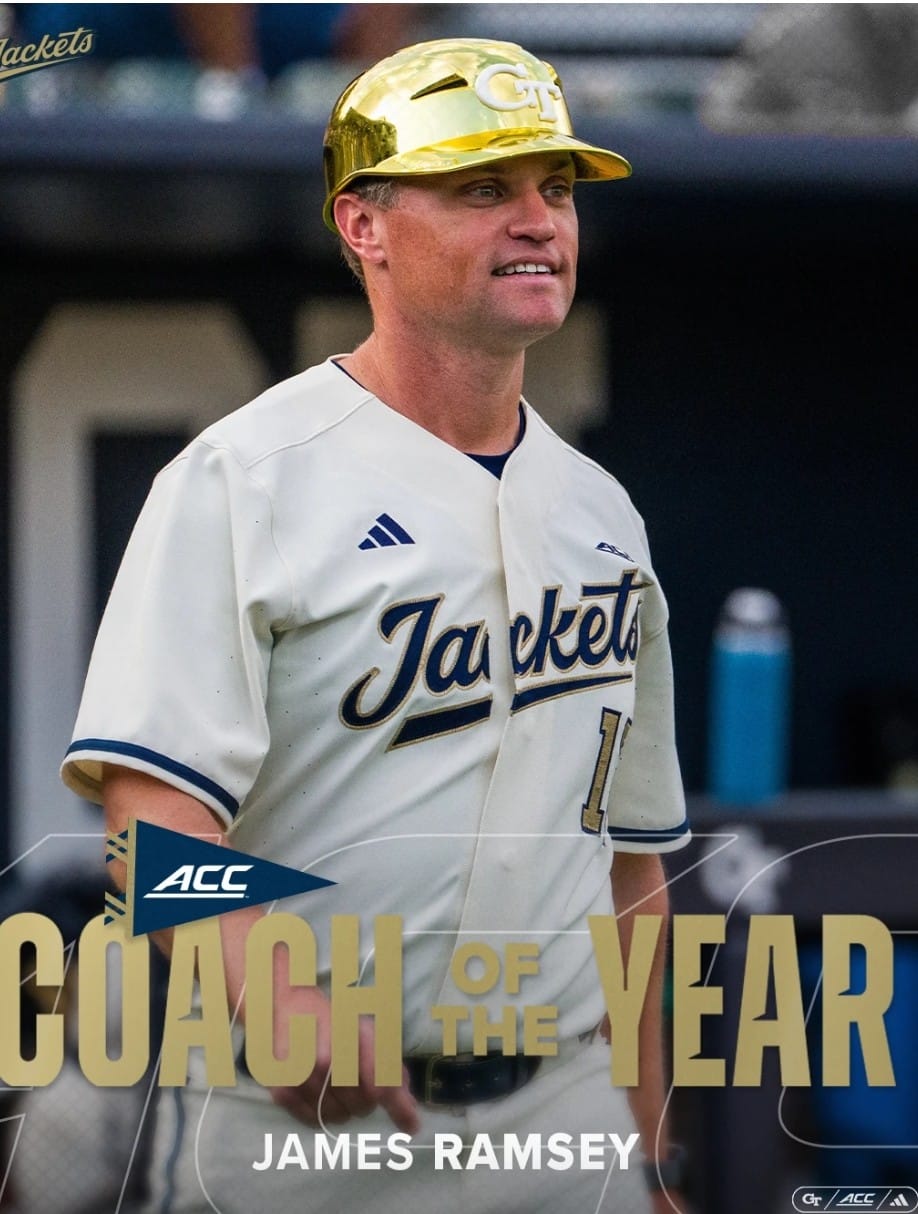
Coach James Ramsey's Georgia Tech Yellow Jackets had a dominant weekend in Charlotte last week, winning three straight games over four days to lock down the ACC 2026 Tournament championship.
Tech's vaunted offense showed out in close proportion to their reputation, with winning margins of six, and six and seven runs, respectively over their three games. They tallied 38 runs over three games, and that was without a couple of ninth innings that were not used.
Those numbers were actually a bit better than their record- setting regular season,.when they averaged 10.7 runs per game. Averaged. 10.7 .
That number tells the most obvious story, but there are plenty of other stats that are borderline ridiculous.
If you seek out some context for a batter's OPS (On base Plus Slugging), you will see that in MLB, a good OPS is .800. Above .900 is considered is excellent, and above 1.000 is elite.
This offensive stat is composed of a slugging component, as well as a component that rewards frequency of getting on base- including primarily walks and base hits.
Thus a batter with a high batting average AND good power numbers will have a high OPS. But those players are rare. Usually a power hitter will have a lower frequency of contact, as the forceful swing that generates power tends to be less precise, with resulting in swings- and- misses.
Conversely, players with a high contact rate tend to have a more controlled swing, and that means less power. Few players have both skills. Players with an OPS over 1.000 are usually placed 2-3-4-5 in the batting order. Beyond that point, on most teams, the batting numbers drop off quite a bit.
Georgia Tech's starting nine in 2026 carry an aggregate OPS of over 1.000. As a team. The number is actually 1.105 for the regular season. All but two of Tech's nine starters are over 1.000. And those two exceptions are over .970.
Those numbers tell you what opponents already know– there are no soft touches in the lineup. None. And if you as a pitcher make a mistake, you likely will pay a price.
Having said all of that, the old axiom in baseball is that championships hinge on defense and pitching. And if that's true, you can sometimes see a hot pitcher shut down an opposing lineup.
Twice this season, Tech has been held to two runs. Once by Pittsburgh. The second time was by North Carolina. Both were losses for Tech.
But those are rare days. Because Tech's ine-up is loaded with players who hit for power AND average. And therefore, there no place to go if for an easy out you're an opposing pitcher. And while all batters sometimes slump, in a lineup like Tech's, someone is always available to get the big hit in the big moments.
You can make the argument that the basis of effective pitching is to steer around trouble as best you can to minimize scoring by your opponent. In most lineups, the final two or three batters you face in the order make contact less often , and to lesser effect, than the guys above them in the order.
However, facing the Yellow Jackets offers no respite. The bottom of the order is just as effective as the top. So a given pitcher will really have to be at the top of his game– inning after inning--to avoid giving up runs against Tech.
So the Jackets went over 10 runs 31 times this year so far. Granted, a 10 run output is no guarantee of a win. But it's a great place to start.
Game One of the Atlanta regional tournament is two days away. That is when the pitching staff of UIC will get a glimpse at Tech hitters in the flesh. Based on the way 2026 has gone so far, it should be interesting.
Patrick Conarro RamblinSports.com