Georgia Tech And Colorado...It's Complicated

Georgia Tech and Colorado have played only once over their long histories. That game, of course, was August of 2025, with the Yellow Jackets winning 27-20. But for a series history so small and recent, the two schools have a rivalry of sorts that goes back much further.
Georgia Tech Coach Brent Key recently alluded to the period in college football's past when it was possible to have a "split" national championship –meaning that two schools could claim the title based on the prevailing ranking systems acknowledged at the time.
Key opined thst he thought the game was better for that change, which officially occurred when the CFP was designed to produce a true ( and justifiable) champion, beginning in 2014.
The last time there was a split championship was in 2003, with LSU and USC each laying claim to the top spot. That wasn't the only time, though.
Tech fans of longer vintage will recall that in 1990 , both Georgia Tech and Colorado held claim to the crown. Colorado won the AP (the sportswriters' poll), while the Yellow Jackets won the UPI (the coaches' poll).
When you look back at how that season unfolded, it's still difficult to see how Georgia Tech did not win both.
First of all, they had an undefeated season, with the only blemish being a tie with UNC. No other Division I school went undefeated. Second, they clearly were on the ascent in overall play, finishing with a resounding 45-21 win over Nebraska in the Citrus Bowl on New Year's Day 1991. Nebraska was the only common opponent for Tech and Colorado. Both teams beat the Cornhuskers.
But the season Colorado posted will forever be controversial. They began the year ranked #5 in the country, but stumbled out of the gate , tying Tennessee and then losing to #21 Illinois in their first three games, yielding a 1-1-1 record. At that point they fell back to #20 in the weekly polls, before beginning what would be a 10 -game winning streak- of sorts. As the regular season ended they were ranked #2. By the time Bowl week was set to finish up on Jan 1, they were #1.
Tech on the other hand, didn't appear in the polls til October, and fell back from #11 to #16 after the tie with ZUNC. They jumped back to #7 , after the defining win over then top- ranked Virginia in Charlottesville. From there Tech crept up to #2 as of Dec 31, facing #19 Nebraska early that day in Orlando.
Meanwhile, Colorado was set to play #5 Notre Dame that night in the Orange Bowl in a rematch from one year earlier.
One day later, with the games decided , the final votes rolled in. Colorado won the AP. Georgia Tech won the UPI. And the public debate was on.
The generally accepted rationale was that Colorado had played a tougher schedule. And Georgia Tech had been tied by an unranked team.
On the other hand, Colorado lost a game , and was tied in another. But oddly, most of the controversy came from two of the games that counted as wins for the Buffaloes.
Their sixth game was a two- point win over Missouri, in which Colorado scored the winning points on the game's last play, which occurred on a fifth down. To this day, it's difficult to comprehend how such a moment could occur. Somehow the chain gain failed to flip the down marker after second down. Thus Colorado was allowed an extra down. Somehow no one noticed– not the refs, nor the coaches, nor the fans– nor the announcers or the TV crew. No one. The Buffs used the real fourth down to clock the ball, allowing time to run one more play, which turned out to be the game winner.
Almost immediately after the play, the refs realized their error, and then held a 20- minute confab before deciding they would let the result stand. The Big Eight office later denied an appeal from the Missouri braintrust, and so the Colorado win streak remained intact. There was more to that story. The refs had called a six- second pause after " 3rd down" when they decided that Missouri was too slow getting up after tackling RB Eric Bieniemy. What's more, many onlookers disputed the validity of the final play touchdown, claiming that Colorado QB Charles Johnson did not actually get into the end zone.
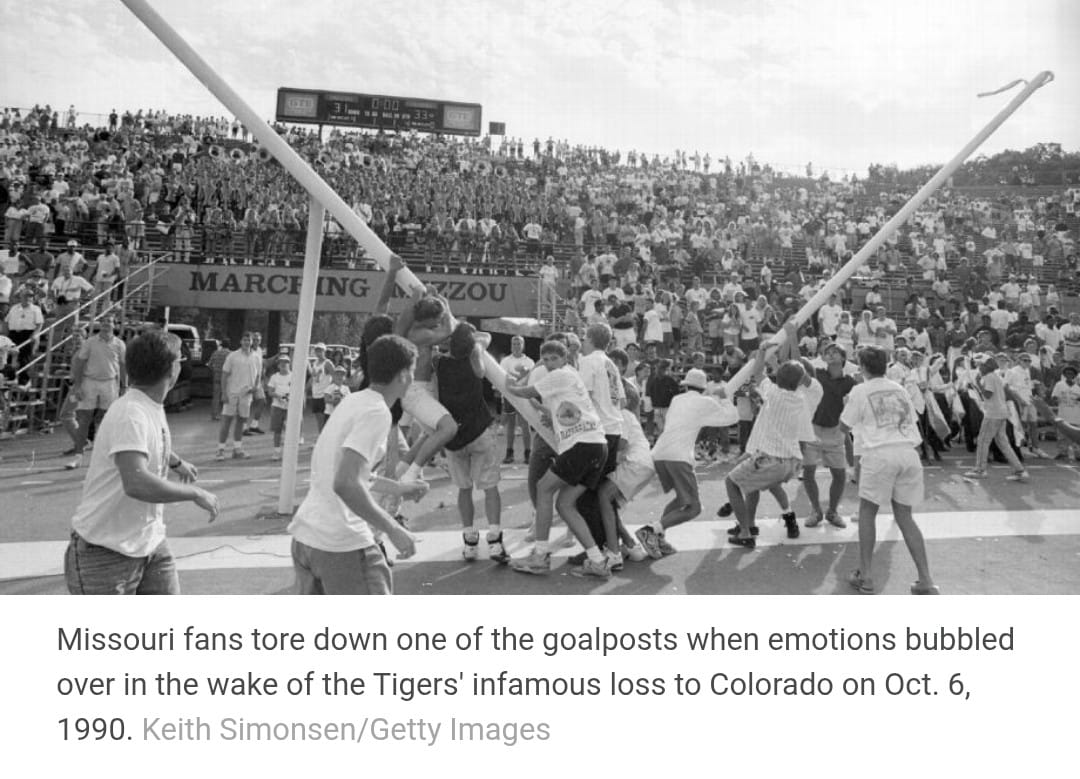
The end- game fury led to a most unusual sight– the fans of the losing team tore down the goalposts at Missouri's Faurot Field .
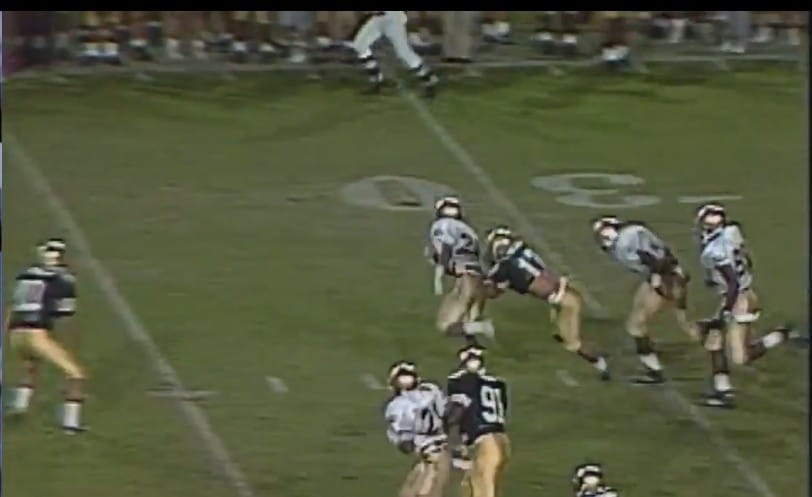
The final game of Colorado's season also had a controversy– in the game's waning moments, Notre Dame punt returner Rocket Ismael returned a punt 91 yards for the go- ahead score. The play was called back on a clipping call that clearly trailed the play. Nevertheless, the call stood, the touchdown nullified was and Colorado won the game.
Tech's narrow win – by a single vote--in the UPI poll included a vote cast for Tech by Nebraska coach Tom Osborne, whose Cornhuskers lost to each team. Of course, Colorado was Nebraska's biggest rival at time, so there's another angle.
Bobby Ross left Tech for the NFL in 1992. Bill McCartney left coaching in 1994 to head up his Christian organization called Promise Keepers.
Although both Tech and Colorado faded from top five level national prominence later in the 1990's, the controversy over these 1990 votes help throw more fuel on the fire of discontent among college football fans who wanted a clear- cut, single champion. The Bowl Championship Series ( BCS) did not quite accomplish lthat goal, as illustrated by the 2003 split mentioned above. It was another step toward a formal playoff system that college football has today at Division I. Teams would need to play 15 or 16 games to reach the championship round, a number that would have been unthinkable in 1990/91.
Patrick Conarro
RamblinSports.com
€