Ramble On: Braves' TV Gabfest Rolls Along-- As BG and CJ Talk..And Talk...A Lot

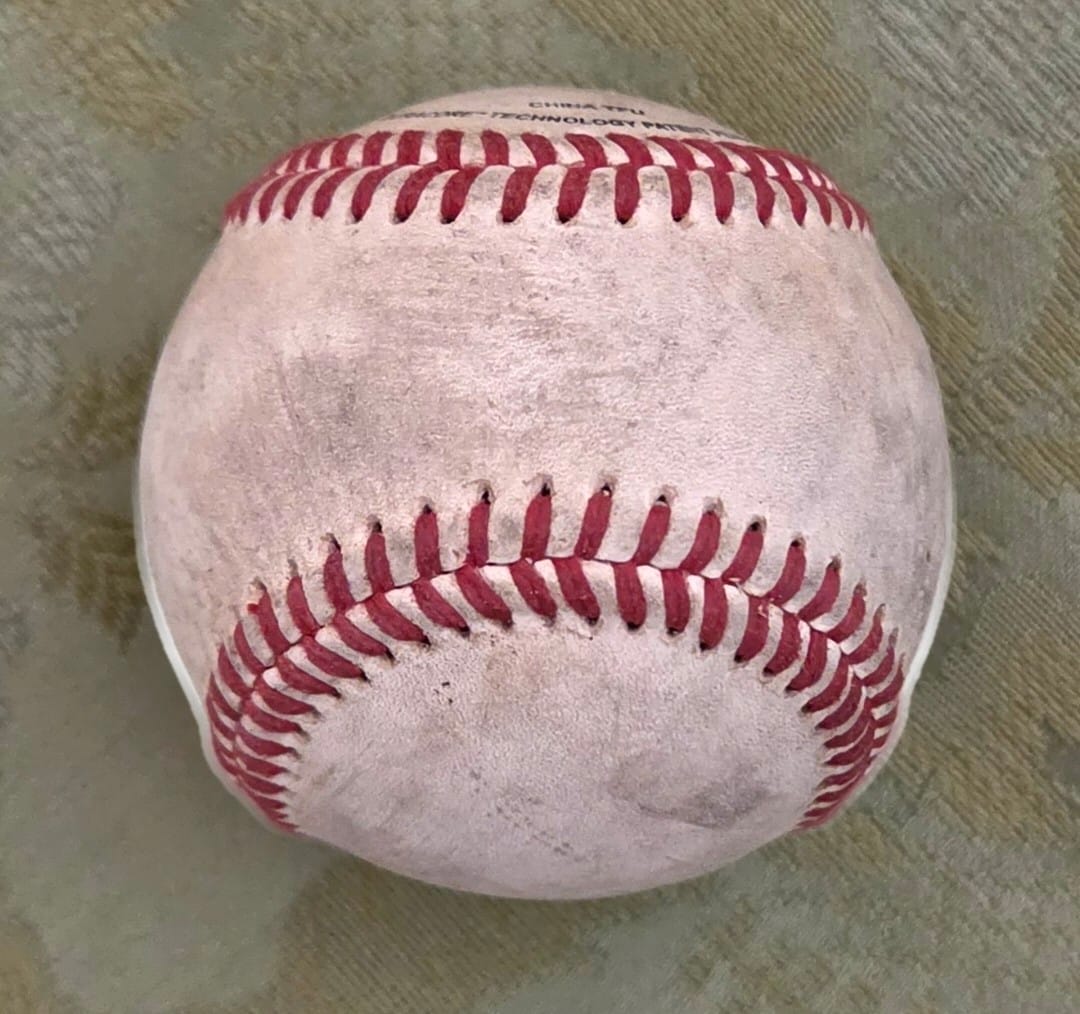
There are 108 stitches in a baseball. And roughly 108 words in any short comment from CJ Nitkowski. Coincidence?
In Year Two of the tenure of the two main broadcasters for televised Braves' games, the verdict is unchanged : meh.
The work of Brandon Gaudin and C.J. Nitkowski isn't growing on me. In fact, they're wearing on me. Not in a harsh way– but in a relentless, recurring , woodpecker-in-the- night sort of way.
Gaudin has a pleasant-enough radio voice. But he tends toward giving us moderate detail in various moments in the game that are obvious to any casual television viewer. That's certainly no crime. I simply prefer a more spare style for TV, without the repetitve narration of the readily- apparent.
Perhaps it is the distinction between announcing a televised game vs. a radio production. There is no need for—nor enhancement from–the broadcasters of a TV game to relate abundant details to describe a play that you are literally watching real-time. You can see the play.
An example might be " ....Albies pulls a foul ball that rolls down the first base line toward the tarp, where Freddie Freeman picks it up."
As opposed to just saying "Strike two".
That bit of extra talk would be much easier to handle if not for the voluminous vocal stylings of his broadcast partner CJ, the color man, who never stops at one sentence if three paragraphs can be created. His routine over-explaining of the most minor moments comes via a slightly mechanical tone. Delivering diatribes with a near- monotonal pitch, his voice takes on a robot- like quality as the sentences grow longer. That feature makes his sometimes specious explanations grow tedious. Think of a big bumblebee hovering near your ear. (If CJ Nitkowski were ever to record an album of greatest hits and sell it retail, it would not be placed in the bin labeled Easy Listening).
Granted, most folks have little control over the basic tone of their voice. One can, and should, however, control the number of words that are generated. Theoretically, anyway. Sometimes I wonder if CJ gets paid by the word.That would be the most straightforward explanation for his over- the-top talkathons.
In addition, Nitkowski has altered our sacred baseball language just a bit. Thus, " barrel" is now a verb, " chase" is a noun and " swing-and- miss" is an adjective. For example," Riley was trying to barrel one up, but Skubal used his best swing- and- miss pitch to try to get some chase.
This horsehide slang can become mind -bending over the course of a three- hour game. And I have yet to even mention "velo", which is street code for velocity. That's not just unnecessary. ..it's borderline pretentious.
Another quirk is of a more straightforward sort. Both Gaudin and Nitkowski are obsessed with pitch counts. These counts are not unimportant, of course. But neither are they immediately and dramatically vital. Nonetheless, both of these guys will begin mentioning pitch counts in the FIRST inning, and then continue to do so, inning by inning, and with increasingly ominous tones. There's a doomsday aspect to their warning that pitcher so-and-so " is up to 30 pitches and we're only in the second inning". As an example, Gaudin on a recent telecast solemnly intoned, " The pitch count continues to climb". What else can a pitch count do?
The way they endlessly warn us, you would never know that there are still pitchers around baseball who can go comfortably over 100 pitches, and managers who will allow them to do so.
Accordingly, it's not necessary– and maybe even a tad misleading– to talk about pitch counts all through the early innings. The numbing effect from this over- speak is akin to the weather guy "warning" us of a new wind storm brewing off the African coast, that may...may... someday... become a local threat– or not. That information is unhelpful in the current moment.
Gaudin, in particular, watches those counts. Sometimes he will also help you with the math. As in tonight's game."That was the tenth pitch of this at bat.( OK). The next pitch will be the eleventh". ( unhelpful)
They likewise love to talk about pitch speeds (velo) and CJ especially opines frequently about what he thinks the pitcher was trying to do. Maybe he knows. Maybe he doesn't. There's a good bit of conjecture, often disguised as expertise.
Another annoyance: twice this past week I've watched as they continued long , winding stories, while neglecting to tell us about an outfield substitution until the new player was actually involved in a play, two outs deep into the inning. Again, not really a big deal, but it is vexing when you consider that their primary job is to tell us those things that we cannot easily see for ourselves.
Finally, I note also a slight bend of our Englisk language, again from Nitkowski. He has a habit of sneaking in a quiet "h" sound on words that have an " str" combination. Examples include ""shtrike" for strike and "shtrong" for strong, or even " exshtremely" for extremely. I'm not sure where that comes from, but it's certainly there, and now when I hear it, it always sounds a bit "shtrange". Once you hear it, you can't not hear it.
You're welcome.
Patrick Conarro
RamblinSports.com